What is DIMPACT?
DIMPACT is a “think and do” coalition aligning industry changemakers and policymakers around meaningful, science-based solutions that reduce the environmental impacts of serving digital media products.
We provide our industry with trusted data, meaningful insights, and easily accessible resources—harmonising intelligence and action toward true pathways that enable our industry to operate sustainably.
We convene working groups focused on important digital media topics. We also offer the DIMPACT tool and methodology to help companies assess the impact of their digital media products.
Part One: Quantification
Estimates of digital media emissions from the IEA, DIMPACT, the Carbon Trust, and the BBC focus on three categories of emissions associated with video streaming:
- End-user devices: Devices used to access content, such as televisions, laptops, desktops, tablets, smart speakers, smartphones, set-top boxes, streaming sticks, and desktop computers. End-user devices make up the majority of emissions.
- Networks: Internet networks transmit content to users, including cables, routers, exchange points, and transmitters. This category also includes networking equipment in users’ homes, such as modems and routers.
- Data centres and Content Delivery Networks: Data centres process and store digital content and support functions such as recommender algorithms and security features. Content delivery networks (CDNs) are servers located near users, so popular content can be stored and delivered quickly when requested without requiring data to be sent from around the world.
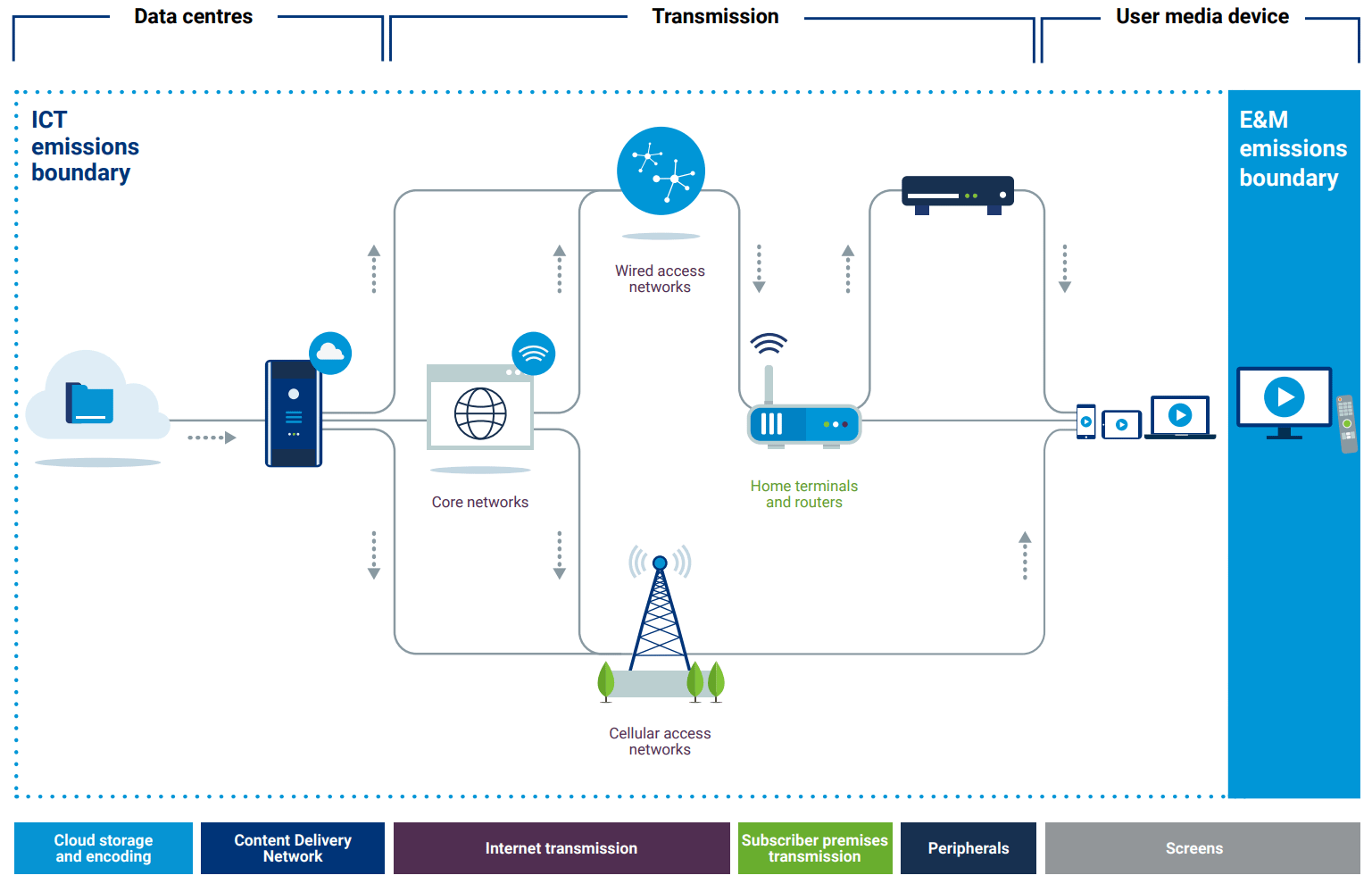
The “life-cycle emissions” of physical infrastructure and hardware used to deliver digital media and entertainment have three parts:
- Use-phase emissions: Emissions from the energy needed to operate infrastructure and hardware. Use-phase emissions account for over two-thirds of GHG emissions from the information and communications technology (ICT) industry, of which digital media is one part.
- Embodied emissions: Emissions from raw material extraction, manufacturing, transportation, and installation of the hardware, often called “cradle-to-gate” emissions.
- End-of-life emissions: Emissions from managing hardware at the end of its life, such as recycling or disposal.
The proportion of emissions associated with each phase varies. The dominant factors include:
- How frequently the hardware is used: Hardware that is used very frequently tends to produce a larger share of emissions during its use phase. For instance, hardware in data centres that is constantly operational has a greater proportion of emissions during use, whereas devices used less often, like televisions, have a higher share of emissions during the embodied phase.
- The energy consumption of the hardware: Higher hardware energy consumption results in increased use-phase emissions throughout the device’s lifetime. For example, battery-powered devices (such as phones) tend to consume less energy during their use phase, despite frequent use, because they are designed to operate for a long time on limited battery power.
- The lifetime of the hardware: The “embodied emissions” of hardware kept in use longer are amortised over a more extended period, increasing the use-phase proportion of its emissions profile. However, the total embodied and use-phase emissions, not their ratio, matter most.
- The emissions intensity of electricity generated to power the component: The carbon intensity of electricity generation depends on the location where the hardware consumes electricity. It has been estimated that 80% of the use-phase emissions from the ICT sector are electricity-based.
The DIMPACT tool only considers use-phase emissions. However, methods for creating high-level estimates of embodied emissions based on recent academic studies are available for participating DIMPACT companies.
Content production can be a significant source of emissions for many media companies, such as emissions driven by fuel, utilities, travel, and housing used to produce media content. Several initiatives focus on decarbonizing content production, including Albert and the Sustainable Entertainment Alliance. This Sustainable Entertainment Alliance White Paper provides guidance on the boundaries between content production and distribution in emissions accounting.
Content consumption (i.e., the end-user devices used to consume content, such as phones, laptops, and TVs) has higher emissions than content distribution (i.e., the infrastructure required to transmit content). This is especially true when larger end-user devices (such as TVs) are used instead of smaller devices (such as phones).
These findings are outlined in more detail DIMPACT’s White Paper on Video Streaming, published in partnership with the Carbon Trust.
A recent Economist study using the DIMPACT methodology reported similar findings for digital publications, including online articles, e-books, and digital journals delivered via websites or apps.
Both are important:
- Energy use refers to the amount of electricity or fuel consumed by devices and infrastructure.
- GHG emissions measure the climate impact of energy use, which depends on how the electricity is generated (e.g. coal vs renewables).
Measuring and reducing GHG emissions should be the primary focus because it captures what matters most for climate outcomes.
Energy use is an important engineering performance metric for optimizing digital products and services and can be directly connected to costs, giving companies a clear business reason to improve. However, GHG emissions will differ based on the carbon intensity of the energy used.
The physical infrastructure and devices that underpin digital media may have location-specific impacts, such as:
- Pollution-related impacts associated with the manufacture of consumer electronics
- Data centre water use in water-stressed areas.
- Noise-related impacts of backup generators at remote mobile network sites.
The following resources provide a high-level understanding of the impacts of different business activities (including those related to digital media) on water and nature:
Part Two: Decarbonisation
Addressing emissions from end-user devices is the top priority for decarbonising the digital media value chain, though other strategies are also important.
- End-user devices: Devices are the primary driver of emissions in the digital media value chain, so improving the energy efficiency of consumer devices is the most critical priority. Recent progress has been tracked through initiatives such as the EU’s energy efficiency labelling program, but continued innovation and widespread adoption of energy-efficient hardware remain essential.
- Consumer actions: Consumers can use energy-saving features on their devices (e.g. eco-mode on TVs), switch off devices when not in use, and choose appropriately sized screens for their space. More tips are available in Netflix’s guidance on reducing carbon emissions.
- Data centres and networks: It is estimated that 80% of emissions from data centres and networks are electricity-related, making the purchase of renewable energy for these operations a key priority. Efficiency improvements, such as transitioning to full-fiber internet networks, also help lower energy demand.
- Measurement matters: Companies should use methodologies that demonstrate actual decarbonization in the real world, rather than relying solely on accounting methods that shift emissions within the value chain. Best practice approaches, such as those outlined in the DIMPACT methodology, guide interventions that achieve meaningful reductions.
Governments can support decarbonisation through public procurement policies (e.g. see Preist, et. al.) and incentivise suppliers to decarbonise and to develop lower-impact products and services. In addition, policymakers can encourage:
- Decarbonisation of electricity grids
- Improvements in the energy efficiency of hardware, such as via energy efficiency labelling
- Innovation in lower-emissions manufacturing and circularity of hardware
- Publication of up-to-date information on energy and emissions by companies
Part Three: Trends
Increased digital media use will not necessarily result in higher emissions. Improvements in the energy efficiency of networks and devices, along with the fact that energy use doesn’t scale linearly with data traffic, complicate the relationship.
There are several potential scenarios:
- The digital media ecosystem’s improved energy efficiency: As digital technologies have scaled, their efficiency has improved, resulting in energy consumption that has not grown at the same rate as their increased use. As demand for digital products and services continues to rise, their overall impact will depend on whether efficiency gains per unit of usage can keep pace with this growth or exceed it.
- The decarbonization of electricity grids: Reducing the carbon footprint of the electricity purchased by viewers and consumers will lessen the impact of end-user devices. Companies can speed up this process by sourcing renewable electricity for their own operations and encouraging their suppliers to do the same.
- The ability to decarbonise the embodied impacts of devices and infrastructure: Taking a full life-cycle view requires considering the embodied emissions of infrastructure and devices across the value chain. Extending product use and designing for reuse, repair, and recycling will lower emissions. It is also important to decarbonize manufacturing, raw material extraction, and transportation.
Digital media itself is not a specific sector of the economy identified as a major contributor to climate change globally. The broader ICT sector has the potential to reduce emissions in other sectors, even if its share of global emissions increases over time.
DIMPACT has established a Working Group to explore this question further.
Increases in GHG emissions from AI are likely to show up in data centre energy use, as more intensive processing is needed to run AI. However, understanding the extent of these impacts requires careful consideration, including how AI's effects compare to non-AI processes that achieve the same results.
DIMPACT is also exploring how AI will affect the broader digital media value chain, including improvements like decarbonising energy grids, optimizing networks for energy efficiency, and AI-enabled energy-saving features on end-user devices.
Part Four: Business Models
Digital media and entertainment products span two sectors where emissions are tracked globally.
- Information, Communication and Technology (ICT)
- Entertainment and Media (E&M)
While emissions estimates vary, the ICT sector is estimated to account for 1.5-4% of global emissions. However, this includes emissions not related to digital media, such as other uses of data centres and networks, as well as the embodied emissions of all ICT sector devices. Additionally, the digital media industry includes physical media products, like paper and print, which are not part of the ICT sector.
Digital advertising is a core part of many media companies’ business models, so its emissions are linked to those of media companies’ content. Advertising can cause extra server use due to how the advertising system delivers ads to users, such as through programmatic bidding. This effect occurs in data centres, which make up a very small part of the overall emissions in the digital value chain. This is an essential and unique factor for the advertising industry.
A recent study from Fraunhofer FOKUS found that viewing the same content live versus on-demand did not affect the energy consumption of the televisions tested in people’s homes.
However, mass viewership of live content simultaneously, such as high-profile sporting events, can create traffic spikes. The energy use of fixed-line internet networks is a high-baseload system, meaning that energy consumption stays steady regardless of traffic volume. However, growth in peak traffic may require more network capacity, potentially increasing embodied emissions as network operators upgrade equipment.
More research is needed to understand the dynamics and effects of this phenomenon and to find potential solutions.
Part Five: Consumer Action
Using digital products and services results in fewer emissions than other everyday activities, such as driving or flying, so many other actions are more significant than changing viewing habits. That said, DIMPACT recommends:
- Switching off devices when they are not in use.
- Reviewing the energy efficiency labelling when buying new devices.
- Using screen sizes suitable for their space (e.g. not using a large screen in a small room).
- Using eco-mode on televisions when a higher-energy mode isn’t required.
- Using smaller devices for individual viewing, saving larger devices for shared viewing.
This is an area of ongoing research.
Internet networks are designed to handle peaks in internet traffic, so increases in peak traffic may require medium- to long-term upgrades, affecting energy use and emissions. However, viewing during peak times is not expected to significantly impact internet networks immediately. Managing peak traffic is an industry challenge, not an action for individual consumers.
Between 60% and 80% of a TV’s lifetime carbon footprint comes from the manufacturing phase. This means it’s likely better to keep an old device longer from a GHG emissions perspective.
However, this depends on several factors, including trends in the efficiency of newer devices, the carbon intensity of electricity from the local grid, and progress in decarbonizing the manufacturing of user devices. More research is needed to provide definitive answers, which will likely vary by case.
If a device no longer supports the media apps a consumer wants to use, then small streaming devices are a low-impact and low-cost way to keep watching without purchasing a new screen.
Lowering resolution is unlikely to affect emissions from viewing digital media. Recent tests indicate that reducing content resolution doesn't significantly change a device's energy consumption, because the television's backlight and brightness account for the majority of energy consumption in these devices.
Increasing data volumes does not have a significant or instantaneous impact on the energy consumption of fixed-line networks. However, viewing content on a mobile device with cellular data—where mobile transmitters' energy use can be more responsive to data traffic—may lead to higher emissions. Many content providers can detect a smaller device on a cellular plan and often choose not to send a high-resolution version, as the higher resolution is unlikely to be noticeable on such a small screen.
Part Six: Future Work
DIMPACT has a list of ‘open questions’ that require further investigation to understand the impact of digital media and the infrastructure on which it depends. For example:
- Can we quantify the environmental impacts of the growth in ‘peak traffic’ in networks? What are the most prominent interventions to manage these peaks?
- What are the prominent use cases for AI in the media sector? How will this change the net impacts of media companies’ emissions?
- How can we understand the overall impact of changes across the entire digital media value chain?